
Generative Engine Optimization
Traditional SEO is dead. Stop building sites for 2012 search crawlers.
If your current web strategy is still focused on keyword stuffing, ten blue links, and manual backlink farms, you are lighting client budget on fire.
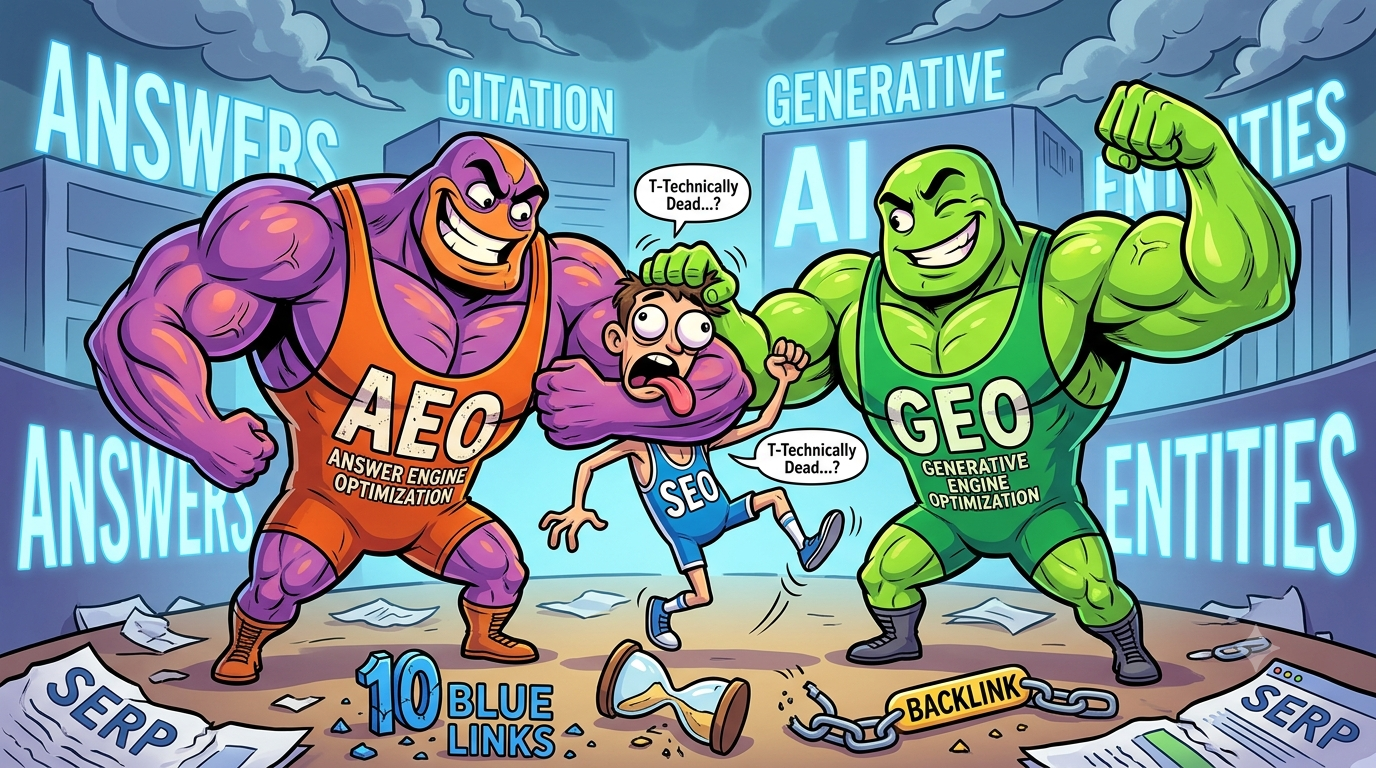
The web is not an index of static links users manually click through anymore. It is an agentic answer ecosystem.
Modern users do not type "best web dev stack" into a search box just to read five separate blog posts. They ask complex, multi-layered queries directly to LLMs, ChatGPT, Perplexity, Gemini, and AI Overviews.
You are not only competing to rank number one on a search engine results page. You are competing to be synthesized, cited, and recommended inside an AI-generated response.
The playbook flipped from Search Engine Optimization to Generative Engine Optimization. Here is the technical breakdown of what changed and how to build for it.
The shift: SEO vs. GEO
Traditional SEO was built for ranking pages. GEO is built for becoming source material inside generated answers.
| Old SEO | Modern GEO |
|---|---|
| Rank number one to three on a search page. | Become part of the AI's synthesized answer and get cited as a source of truth. |
| Target crawlers matching exact string keywords to queries. | Target RAG pipelines, vector databases, and LLM context windows. |
| Publish SEO-bloated articles targeting high keyword volume. | Publish high information gain, structured Q&A, entity consensus, and empirical data. |
| Rely on hyperlinked domain authority and backlink quantity. | Build brand entity clarity, multi-platform consensus, and raw unlinked mentions across the web. |
1. Entity clarity and knowledge graph anchoring
AI models do not read your site as disconnected HTML pages. They process it as a network of entities: people, products, services, categories, and concrete concepts.
Your site must state explicitly who you are, what category you own, and what problems you solve. Zero ambiguity.
- Define your entity: Make the brand name, founder name, product names, categories, and offers unmistakable.
- Use dense JSON-LD schema: Add Organization, Person, Product, TechArticle, BlogPosting, FAQPage, and Service markup where appropriate.
- Create cross-platform consensus: Keep your brand name, offerings, and technical specs consistent across GitHub, LinkedIn, Crunchbase, directories, and product databases.
2. Maximize information gain
Generative engines ignore generic summaries because the base model already knows them. To earn citations, your page has to provide something meaningfully new.
Publish proprietary benchmarks, custom code implementations, real teardown notes, architecture decisions, survey results, performance tests, pricing logic, or case studies. Generic "what is X" articles are not enough anymore.
Real first-person experience matters because it gives AI systems material that cannot be replaced by a dictionary answer.
3. Use answer-first, chunkable structure
RAG pipelines scan content, slice it into embeddings, and pull the most relevant snippets into answers. Your page should be easy to chunk, quote, and understand without hidden UI tricks.
- Start technical sections with a direct micro-answer before expanding the context.
- Use semantic HTML: clean headings, paragraphs, lists, and tables.
- Use comparison matrices for "Tool X vs Tool Y" and "old way vs modern way" queries.
- Avoid hiding critical content inside JavaScript-only accordions, tabs, or client-rendered fragments.
4. Server-side rendering is non-negotiable
Most major AI web crawlers operate under strict compute limits. GPTBot, PerplexityBot, ClaudeBot, and similar systems frequently avoid executing heavy client-side JavaScript.
If your critical content only appears after client-side rendering, AI crawlers may see a thin or blank page and cite a competitor instead. Pre-rendering or server-side rendering on public routes is now an operational requirement.
5. Build web consensus and unlinked brand mentions
LLMs ingest the web as raw text tokens, not just as hyperlink graphs. They read context around your name, products, services, and technical claims.
When your brand is repeatedly mentioned alongside specific topics on Reddit, Hacker News, YouTube, GitHub, developer forums, podcasts, directories, and social platforms, vector models naturally connect your brand to those concepts even without a backlink.
The modern authority game is not only "who links to you." It is also "what does the web repeatedly say you are trusted for?"
Modern project execution checklist
- Crawler access: Audit robots.txt and make sure you are not accidentally blocking major AI crawlers unless that is intentional.
- Schema audit: Validate JSON-LD across every core route so brand, service, and article relationships are explicit.
- Chunkable layouts: Structure documentation into direct Q&A blocks with bold leading sentences.
- Entity verification: Claim and enrich brand profiles across GitHub, Product Hunt, Trustpilot, directories, and relevant public databases.
- AI visibility audits: Track how your brand surfaces in answer engines, not just traditional Google Search Console positions.
Traditional SEO is not useless because search disappeared. It is outdated when it only optimizes for the old surface.
The new goal is clear: build pages that humans trust, crawlers can parse, and AI systems can confidently cite.